
The video begins at 4:13.
Wei Feng: Impacts of Economic, Technological and Operational Factors on the Economic Competitiveness of Electric Commercial Vehicles in Fleet Replacement Decisions
Electric commercial vehicles (ECV) have the potential to substantially reduce greenhouse gas emissions, noise, and pollution in urban areas. In addition, ECVs have lower per-mile operating costs and potentially lower maintenance costs. However, the initial purchase cost of ECVs is significantly higher than the purchase cost of a conventional diesel vehicle. From a purely economic perspective, there is a cost tradeoff between the low operating and maintenance costs of ECVs and their high initial capital costs. In this paper, a fleet replacement optimization framework is employed to analyze the competitiveness of ECVs. Scenarios with different fleet utilization, fuel efficiency and sensitivity analysis of ten additional factors indicate that ECVs are more cost effective when conventional diesel vehicles’ fuel efficiency is low (8.2 miles/gallon) and daily utilization is more than 54 miles. Breakeven values of some key economic and technological factors that separate the competitiveness between ECVs and conventional diesel vehicles are calculated in all scenarios. For example, in low conventional diesel vehicle fuel efficiency and low daily utilization scenario, ECVs are more competitive when their purchase prices...
Read moreView the presentation slides here.
This project builds on the success of NITC’s first Pooled Fund project that created the first national...
Read more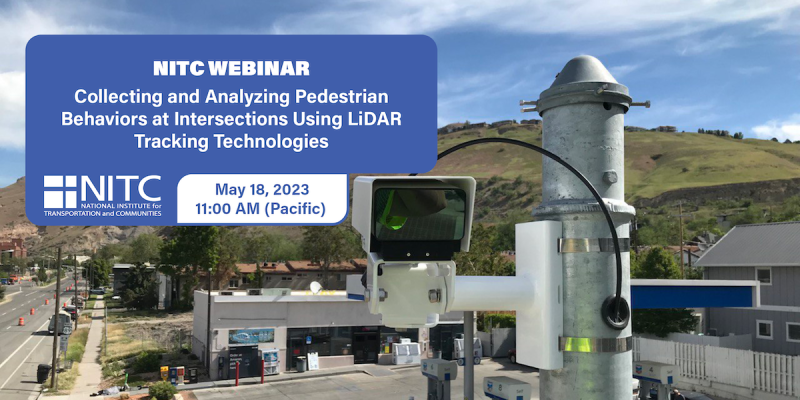
PRESENTATION ARCHIVE
OVERVIEW
The aim of this research is to investigate pedestrian behavior at signalized intersections using state-of-the-art LIDAR sensing technologies and to use this data, along with vehicular data, to develop a more effective multimodal signal control system.
In the presentation, the presenters will describe a novel method of collecting pedestrian crossing behaviors at signalized intersection, discuss the findings and implications of data analytics, and introduce a novel approach to dynamic flashing yellow arrow mechanisms to reduce the conflict between left turn vehicles and crossing pedestrians.
KEY LEARNING OUTCOMES
- Understand the framework of LiDAR sensing solutions;
- Understand how to collect pedestrian behaviors at intersections;
- Understand how to provide new protection for crossing pedestrians with object-tracking technologies.
THE RESEARCH
This webinar is based on a study funded by the National Institute...
Read moreThe video starts at 0:58.
View slides
Abstract: Walking and bicycling are being promoted as transportation options that can increase the livability and sustainability of communities, but the automobile remains the dominant mode of transportation in all United States metropolitan regions. In order to change travel behavior, researchers and practitioners need a greater understanding of the mode choice decision process, especially for walking and bicycling.
This presentation will summarize dissertation research on factors associated with walking and bicycling for routine travel purposes, such as shopping. More than 1,000 retail pharmacy store customers were surveyed in 20 San Francisco Bay Area shopping districts in fall 2009, and 26 follow-up interviews were conducted in spring and summer 2010. Mixed logit models showed that walking was associated with shorter travel distances, higher population densities, more street tree canopy coverage, and greater enjoyment of walking. Bicycling was associated with shorter travel distances, more bicycle facilities, more bicycle parking, and greater enjoyment of bicycling. Respondents were more likely to drive when they perceived a high risk of crime, but automobile use was discouraged by higher employment densities, smaller parking lots,...
Read morePortland State students redesign busy Portland street for active transportation
The video begins at 5:27.
View slides
Abstract: Today, most streets are designed and managed to meet mobility standards that focus on the movement of motor vehicles, failing to adequately accommodate and prioritize transit, walking, and biking. A new culture of innovation is needed in transportation as traditional solutions alone will not suffice. By 2035, the Portland Plan envisions transportation facilities that are designed and managed to prioritize travel investments that improve walking, biking, and universal accessibility as the first priority.
In support of this vision, Peter Koonce, Manager of the City's Signals, Street Lighting, & ITS Division will discuss how he's looking to make the City's traffic signals consistent with these goals resulting in more effective integration of land use, transit, cycling, and walking. The discussion will be centered around research that is needed to improve our understanding of best practices from the U.S. and Europe for application in Portland.