PRESENTATION ARCHIVE

OVERVIEW

Gateway communities are the small towns outside of national parks, forests, scenic rivers, and ski resorts. This presentation will highlight the housing, transportation, and development challenges that these communities faced in the aftermath of the COVID 19 pandemic. Our study...

Read more

PRESENTATION ARCHIVE

OVERVIEW

A summary of collaborative research project conducted in Tucson, AZ studying mobility related challenges refugees experience after their resettlement.

KEY LEARNING OUTCOMES

  • While resettlement typically allows millions of forcibly displaced persons to escape from unpredictable and often dangerous conditions of displacement, most refugees experience an array of challenges after resettlement as they integrate into new
    communities.
  • Many of these challenges are related to their ability to get to and from places that are important to their sense of autonomy and well-being, including sites of education, employment, worship and medical care.
  • In this talk, Dr. Myadar will present some of the key findings of her collaborative research project on mobility-related challenges faced by refugees in Tucson, Arizona after their resettlement.

THE RESEARCH

This webinar is based on a study funded by the National Institute for...

Read more
PRESENTATION ARCHIVE

OVERVIEW

Heat is the number one weather-related killer in the United States, and the implications of heat impacts range from individual transportation users, to emergency management services, and entire transportation networks and systems. In this presentation, we'll cover key concepts for urban planning and heat resilience, including heat mitigation and management strategies. Additionally, we will discuss the original NITC-sponsored data collection evaluating one such cool corridor strategy--PlusTI cool pavement rejuvenator--and the associated challenges of researching impacts of strategies on human-comfort in natural and built environments.

KEY LEARNING OUTCOMES

The audience will walk away with:

  • an understanding of planning for urban heat resilience;
  • the ability to recognize and differentiate heat mitigation and management strategies;
  • an understanding of the impacts of heat on transportation users and systems;
  • an ability...
Read more
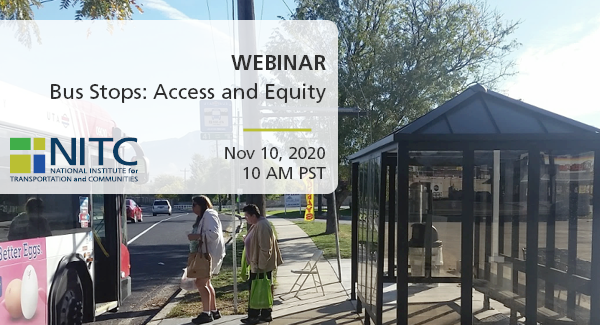
A bus stop with a shelter, bench, and sidewalk showing people boarding the bus
 

PRESENTATION ARCHIVE

OVERVIEW

Improving bus stops by providing shelters, seating, signage, and sidewalks is relatively inexpensive and popular among riders and local officials. Making such improvements, however, is not often a priority for U.S. transit providers because of competing demands for capital funds and a perception that amenities are not tied to measurable increases in system effectiveness or efficiency. This webinar focuses on the role that bus stops play as the point of first contact between transit agencies and their potential riders, and how the quality of that contact can influence both ridership and accessibility for riders with mobility-related disabilities. The webinar will use results from recent research sponsored by NITC and the Utah Department of Transportation looking at possible impacts that bus stop improvements made by the Utah Transit Authority (UTA) have had on stop-level ridership and demand for Americans with Disabilities Act (ADA) paratransit services. The results demonstrate how investments in bus stop facilities are not...

Read more
Aerial view of urban city road with cars on the road and crosswalk. Text reads: Webinar: Land Use and Transportation Policies for a Sustainable Future.
 

PRESENTATION ARCHIVE

OVERVIEW

Even though there are tremendous uncertainties in the timing and evolution path of the Autonomous Vehicles (AV) technology, it may become a likely reality within most MPOs' long-range regional transportation plan horizon of twenty years. Yet a recent survey of the largest MPOs in the US indicates only one of them "even mentions driverless, automated, or autonomous vehicles in its most recent RTP". One of the uncertainties in assessing the impacts of AV is their direction: on one hand, self-driving cars could increase VMT by increasing roadway capacity, lowering costs of travel; on the other, they may reduce VMT by enabling more car-sharing, improving access to transit, eliminating the fixed costs of car ownership, and reclaiming parking space. To date, there is no suitable conceptual framework or modeling tools available to MPOs for quantitatively assessing the likely long-term effects of AV or potential policy scenarios.

This project studies the possible impacts on travel and land use of the emerging AV technology and focuses on advancing this innovative mobility option by...

Read more

Pages