Social Transportation Analytic Toolbox (STAT) for Transit Networks


PRESENTATION ARCHIVE

Miss the webinar or want a look back?

OVERVIEW

This webinar will present an open-source socio-transportation analytic toolbox (STAT) for public transit system planning. This webinar will consist of a demonstration of the STAT toolbox, for the primary purpose of getting feedback from transit agencies on the tool's usefulness. We are especially interested in hearing about any improvements that would aid transit agencies in implementing it.

The STAT toolbox was created in an effort to integrate social media and general transit feed specification (GTFS) data for transit agencies, to aid in evaluating and enhancing the performance of public transit systems. The toolbox enables the integration, analysis, and visualization of two major new open transportation data sources—social media and GTFS data—to support transit decision making. In this webinar, we will introduce how we...

Read more
 

PRESENTATION ARCHIVE

OVERVIEW

This webinar will introduce you to the concept of the Community Transportation Academy (CTA), a model which has been operating in Portland for over 30 years in the form of the Portland Traffic and Transportation (PTT) class. Now catching on in other cities, the project team recently implemented the Wasatch Transportation Academy (WTA) in Salt Lake City. The presenters also include key stakeholders (and guest lecturers) in the WTA, and the PTT instructor. The presentation will include discussions about why CTAs can be good for both community members and transportation agencies/practitioners, and how you can bring a CTA to your city.

KEY LEARNING OUTCOMES

  • How to make interactions between community members and transportation agencies more effective
  • How to increase human capital and community capacity by teaching community members how and where they can engage in transportation decision-making processes
  • Lessons from transportation...
Read more
New Travel Demand Models

PRESENTATION ARCHIVE

OVERVIEW

Conventional four-step travel demand models are used by nearly all metropolitan planning organizations (MPOs), state departments of transportation, and local planning agencies, as the basis for long-range transportation planning in the United States. A flaw of the four-step model is its relative insensitivity to the so-called D variables. The D variables are characteristics of the built environment that are known to affect travel behavior. The Ds are development density, land use diversity, street network design, destination accessibility, and distance to transit. In this seminar, we will explain how we developed a vehicle ownership model (car shedding model), an intrazonal travel model (internal capture model), and mode choice model that consider all of the D variables based on household travel surveys and built environmental data for 32, 31, and 29 regions, respectively, validates the models, and demonstrates that the models have far better predictive accuracy than Wasatch Front Regional Council (WFRC)/Mountailand Association of Governments’ (MAG) current models.

In this webinar, researchers Reid Ewing and Sadegh Sabouri will...

Read more

Smart Growth America hosted a webinar Jan. 31 on NITC research finding that standard guidelines lead to a drastic oversupply of parking at transit-oriented developments. That restricts the supply of housing, office and retail space while driving up the price.

The webinar marks the release of Smart Growth America's lay summary of the NITC report, called "Empty Spaces," which will be available to webinar attendees.

Watch the recorded webinar here.

The research, led by Reid Ewing of the University of Utah, is one of the first comprehensive data-driven reports to estimate peak parking and vehicle trip generation rates for transit-oriented development projects, as well as one of the first to estimate travel mode shares for TODs. Ewing analyzed data on actual parking usage and total trip generation near five transit stations: Redmond, Washington; Rhode Island Row in Washington, D.C.; Fruitvale Village in Oakland, California; Englewood, Colorado; and Wilshire/Vermont in Los...

Read more
Webinar: Visual Exploration of Trajectory Data
 

PRESENTATION ARCHIVE

OVERVIEW

This webinar will demonstrate the tremendous value of GPS trajectory data in understanding statewide travel patterns and measuring performance. First, Dr. Markovic (U of Utah) will conduct visual exploration of GPS trajectories that capture about 3% of all the trips in Utah. He will briefly discuss the problem of scaling GPS trajectories to the population, and then focus on the use of scaled trajectories in computing origin-destination matrices, vehicle-hours delays, vehicle-miles traveled, and trip-based performance measures. Second, Dr. Franz (CATT Lab) will demonstrate a suite of visual analytics that enables transportation agencies to easily explore terabytes of GPS trajectory data. He will demonstrate different tools and share the experience of 5 state DOTs that are currently using CATT Lab's trajectory data suite.

KEY LEARNING OUTCOMES

  • Trajectory data represents the most complete vehicle-probe data and provides unprecedented opportunity for transportation system analysis.
  • Transportation agencies can easily leverage visual analytics to obtain insights in statewide traffic patterns and...
Read more

PRESENTATION ARCHIVE

OVERVIEW

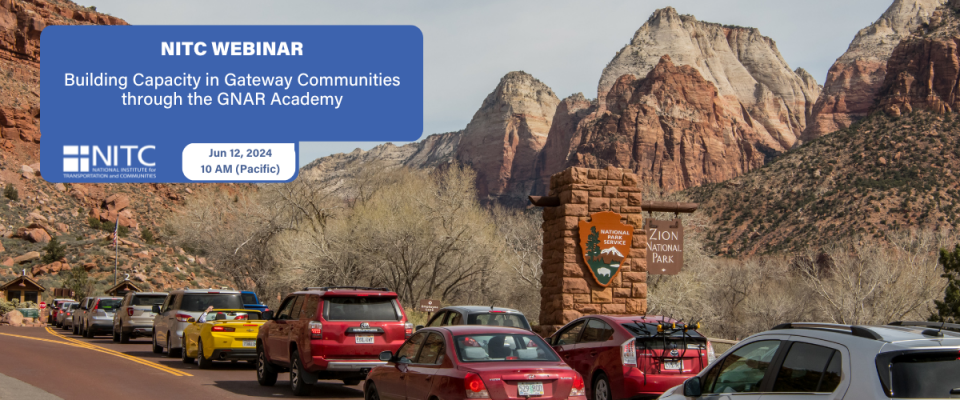
Gateway communities are the small towns outside of national parks, forests, scenic rivers, and ski resorts. This presentation will highlight the housing, transportation, and development challenges that these communities faced in the aftermath of the COVID 19 pandemic. Our study...

Read more


PRESENTATION ARCHIVE

Small towns and cities outside of national parks and other major natural amenities throughout the western United States are becoming increasingly popular places to visit and live. As a result, many of these gateway and natural amenity region (GNAR) communities—including places such as Jackson, Wyoming, and Moab, Utah—are facing a variety of “big city” issues, such as severe congestion, lack of affordable workforce housing, and concerns about sprawl and density. This webinar will introduce the planning and transportation concerns being experienced by GNAR communities throughout the west. It will then share the tools and resources developed by the University of Utah to train planners to work in these unique communities and to help these communities enhance livability and sustainable transportation options. The webinar will also introduce the University of Utah’s new Gateway and Natural Amenity Region Initiative and ongoing research aimed at better understanding and addressing the planning and transportation issues in GNAR communities. 

... Read more
Connected Vehicle System Design for Signalized Arterials
 

PRESENTATION ARCHIVE

OVERVIEW

It can be expected that connected vehicles (CVs) systems will soon go beyond testbed and appear in real-world applications. To accommodate a large number of connected vehicles on the roads, traffic signal control systems on signalized arterials would require supports of various components such as roadside infrastructure, vehicle on-board devices, an effective communication network, and optimal control algorithms. In this project, we aim to establish a real-time and adaptive system for supporting the operations of CV-based traffic signal control functions. The proposed system will prioritize the communication needs of different types of CVs and best utilize the capacity of the communication channels. The CV data sensing and acquisition protocol, built on a newly developed concept of Age of Information (AoI), will support the feedback control loop to adjust signal timing plans.

Our multidisciplinary research team, including researchers from transportation engineering and electrical engineering, will carry out the project tasks along four directions that capitalized on the PIs’ expertise:

  1. Data collection and...
Read more

PRESENTATION ARCHIVE

OVERVIEW

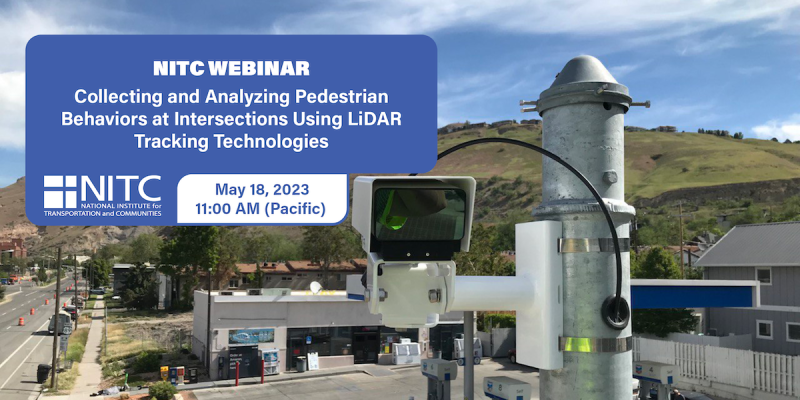
The aim of this research is to investigate pedestrian behavior at signalized intersections using state-of-the-art LIDAR sensing technologies and to use this data, along with vehicular data, to develop a more effective multimodal signal control system.

In the presentation, the presenters will describe a novel method of collecting pedestrian crossing behaviors at signalized intersection, discuss the findings and implications of data analytics, and introduce a novel approach to dynamic flashing yellow arrow mechanisms to reduce the conflict between left turn vehicles and crossing pedestrians.

KEY LEARNING OUTCOMES

  • Understand the framework of LiDAR sensing solutions;
  • Understand how to collect pedestrian behaviors at intersections;
  • Understand how to provide new protection for crossing pedestrians with object-tracking technologies.

THE RESEARCH

This webinar is based on a study funded by the National Institute...

Read more


A bus stop with a shelter, bench, and sidewalk showing people boarding the bus
 

PRESENTATION ARCHIVE

OVERVIEW

Improving bus stops by providing shelters, seating, signage, and sidewalks is relatively inexpensive and popular among riders and local officials. Making such improvements, however, is not often a priority for U.S. transit providers because of competing demands for capital funds and a perception that amenities are not tied to measurable increases in system effectiveness or efficiency. This webinar focuses on the role that bus stops play as the point of first contact between transit agencies and their potential riders, and how the quality of that contact can influence both ridership and accessibility for riders with mobility-related disabilities. The webinar will use results from recent research sponsored by NITC and the Utah Department of Transportation looking at possible impacts that bus stop improvements made by the Utah Transit Authority (UTA) have had on stop-level ridership and demand for Americans with Disabilities Act (ADA) paratransit services. The results demonstrate how investments in bus stop facilities are not...

Read more

Pages